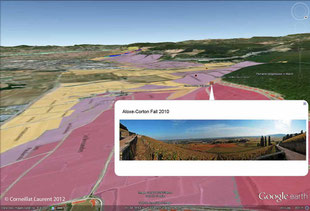
Interactive map of the côte d’or vineyard


  • You can locate on this map of the quite precise places. (Double click on the map to zoom in).


  • I selected for you the best places I visited in slope of Beaune and slope of Nuîts Saint Georges. Those are located by the small ones signed. While Clicking on, you can open an explanatory window, images etc.
  • You can also select places chosen in the side column with a click on “pictures of vines”.


Good exploration!


Interactive view of the vineyard of Côte D'Or with Google Map.

Interactive view of the vineyard of Côte D'Or with Google Earth.

Download an interactive view of the vineyard of Côte D'Or with google earth.
The vineyard of Cote d'or 3D.kml
Place de marché Google Earth [979.8 KB]
Télécharger

Or click here to see the vineyard of Côte d'Or

You need the latest version of the plugin of Google earth to see the map on your browser.


Please wait until the complet douwnload of the map before starting to explore.


Please, wait until the complete download of the map before starting to explore.


Get the map in full screen


Share

download google earth. Download google earth.


To use the interactive view of the vineyard of Côte D'Or in 3 dimensions, you need Google Earth's program.


Get the world's geographic information at your fingertips.

Climats of Pommard

Vineyards of Pommard Vineyards of Pommard
Maps of the vineyards of Burgundy Maps of the vineyards of Burgundy

The Burgundy region runs from Auxerre in the north down to Mâcon in the south, or down to Lyon if the Beaujolais area is included as part of Burgundy. Chablis, a white wine made from Chardonnay grapes, is produced in the area around Auxerre. Other smaller appellations near to Chablis include Irancy, which produces red wines and Saint-Bris, which produces white wines from Sauvignon Blanc.


Some way south of Chablis is the Côte d'Or, where Burgundy's most famous and most expensive wines originate, and where all Grand Cru vineyards of Burgundy (except for Chablis Grand Cru) are situated.

The Côte d'Or itself is split into two parts: the Côte de Nuits which starts just south of Dijon and runs till Corgoloin, a few kilometers south of the town of Nuits-Saint-Georges, and the Côte de Beaune which starts at Ladoix and ends at Dezize-les-Maranges.


The wine-growing part of this area in the heart of Burgundy is just 40 kilometres (25 mi) long, and in most places less than 2 kilometres (1.2 mi) wide.

The area is made up of tiny villages surrounded by a combination of flat and sloped vineyards on the eastern side of a hilly region, providing some rain and weather shelter from the prevailing westerly winds.


  • The basic wines "Reginal appellations" are situated in the begining of the Saone plaine in the east side of the D 974 road.
  • The relatively ordinary "Village" wines are produced from the flat territory nearer the villages at the bottom of the slope.
  • The best wines - from "Grand Cru" vineyards - of this region are usually grown from the middle and higher part of the slopes, where the vineyards have the most exposure to sunshine, with a soil very thin (in some vineyards, a layer of only 50 cm) and the best drainage, while the "Premier Cru" come from a little less favourably exposed slopes.The Côte de Nuits contains 24 out of the 25 red Grand Cru appellations in Burgundy, while all of the region's white Grand Crus are located in the Côte de Beaune. This is explained by the presence of different soils, which favour Pinot Noir and Chardonnay respectively.

Further south is the Côte Chalonnaise, where again a mix of mostly red and white wines are produced, although the appellations found here such as Mercurey, Rully and Givry are less well known than their counterparts in the Côte d'Or.

Below the Côte Chalonnaise is the Mâconnais region, known for producing large quantities of easy-drinking and more affordable white wine. Further south again is the Beaujolais region, famous for fruity red wines made from Gamay.

Burgundy experiences a continental climate characterized by very cold winters and hot summers. The weather is very unpredictable with rains, hail, and frost all possible around harvest time. Because of this climate, there is a lot of variation between vintages from Burgundy.